Self-Improvement Blogs
Embark on a transformative journey with our self-improvement
blog. Elevate your life with practical tips, insightful articles, and expert
advice on personal growth, mindfulness, and success. Discover the power within
you to cultivate positive habits, overcome challenges, and live a more
fulfilling life. Your journey to becoming the best version of yourself starts
here!
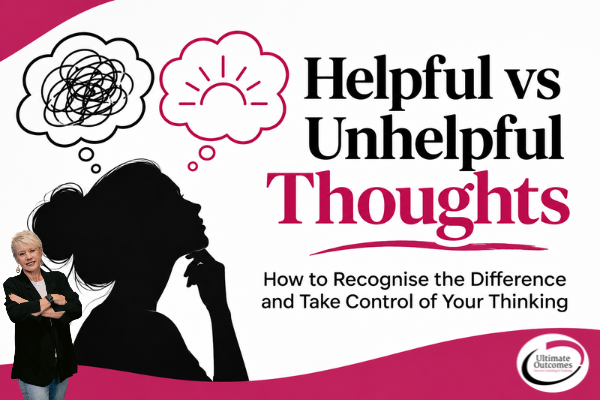
Helpful vs Unhelpful Thoughts: How to Recognise and Change Your Thinking
Your thoughts influence how you feel, the decisions you make, and the way you respond to life's challenges. But not every thought you have is helpful, accurate, or deserving of your attention.
Have you ever caught yourself thinking, "I'm not good enough," "What if I fail?" or "I always get things wrong"?
Perhaps you've talked yourself out of an opportunity before even trying, replayed a conversation wondering what you should have said differently, or assumed the worst about a situation without knowing all the facts.
We all experience thoughts like these. Our minds are constantly interpreting information, making predictions, evaluating experiences, and trying to protect us from potential challenges.
However, just because we think something doesn't mean it's true.
Learning to recognise the difference between helpful and unhelpful thoughts is an important self-improvement skill. It can help you develop greater self-awareness, build confidence, manage difficult emotions, and make more intentional choices.
The good news? You don't need to control every thought that enters your mind. You can learn to change how you respond to those thoughts.
Understanding the Power of Your Thoughts
Our thoughts, emotions, and behaviours are closely connected.
The way we interpret a situation can influence how we feel about it, which can then affect what we do next.
Consider this example.
You've been asked to give a presentation at work.
An unhelpful thought might be:
"I'm terrible at public speaking. Everyone will think I don't know what I'm talking about."
This thought might lead to anxiety, self-doubt, and a desire to avoid the presentation altogether.
A more helpful thought might be:
"Public speaking makes me nervous, but I can prepare, practise, and improve with experience."
You may still feel nervous, but you're more likely to approach the situation with confidence and take constructive action.
The situation hasn't changed. What has changed is how you're interpreting it.
This connection between thoughts, feelings, and behaviours is a central principle of Cognitive Behavioural Therapy (CBT), an evidence-based psychological approach that helps people recognise and respond to unhelpful thinking and behaviour patterns.
You don't need to be in therapy to benefit from developing greater awareness of your thinking habits.
What Makes a Thought Helpful or Unhelpful?
It's important to understand that helpful thoughts aren't necessarily positive thoughts, and unhelpful thoughts aren't always negative ones.
A helpful thought is generally one that supports a realistic understanding of a situation and allows you to respond constructively.
An unhelpful thought may be inaccurate, overly critical, exaggerated, or focused on possibilities that are outside your control.
Helpful thoughts tend to:
Reflect a balanced and realistic perspective.
Encourage problem-solving and constructive action.
Allow room for mistakes, learning, and personal growth.
Support self-compassion and emotional resilience.
Help you focus on what you can influence or control.
Unhelpful thoughts tend to:
Assume the worst without sufficient evidence.
Involve harsh self-criticism or unrealistic expectations.
Focus excessively on past mistakes or future worries.
Create unnecessary fear, guilt, or self-doubt.
Encourage avoidance, procrastination, or giving up.
For example, thinking "I made a mistake, and I need to work out how to fix it" may feel uncomfortable, but it's helpful because it encourages responsibility and action.
On the other hand, thinking "I made a mistake, so I must be a failure" turns one experience into a negative judgement about your entire identity.
The goal isn't to eliminate negative thinking. It's to develop thinking patterns that are accurate, flexible, and supportive of your wellbeing.
Common Unhelpful Thinking Patterns to Look Out For
Many unhelpful thoughts follow recognisable patterns, sometimes called cognitive distortions.
These are habitual ways of interpreting experiences that can cause us to overlook important information or draw conclusions that aren't fully supported by the facts.
Recognising these patterns is often the first step towards changing them.
1. All-or-Nothing Thinking
This happens when you view situations in extremes, with little room for anything in between.
Example: "If I can't do it perfectly, there's no point trying."
A more helpful perspective: "Progress doesn't require perfection. Every attempt gives me an opportunity to learn."
All-or-nothing thinking can make personal growth particularly challenging because it creates unrealistic standards for success.
2. Catastrophising
Catastrophising involves imagining the worst possible outcome and treating it as though it's likely or inevitable.
Example: "If I make a mistake during this meeting, I'll lose everyone's respect."
A more helpful perspective: "I might make a mistake, but that doesn't mean the entire meeting will go badly. I can handle challenges as they arise."
3. Mind Reading
This occurs when you assume you know what someone else is thinking without having clear evidence.
Example: "She didn't respond to my message. She must be upset with me."
A more helpful perspective: "There could be several reasons she hasn't replied. I don't have enough information to know what she's thinking."
4. Overgeneralisation
Overgeneralisation happens when you take one negative experience and apply it broadly to other situations.
Example: "I didn't get the job, so I'll never be successful."
A more helpful perspective: "This opportunity didn't work out, but it doesn't determine what will happen next."
5. Discounting the Positive
This involves dismissing achievements, compliments, or positive experiences while placing greater importance on perceived failures.
Example: "I only succeeded because I got lucky."
A more helpful perspective: "Other factors may have contributed, but my preparation and effort also played a role."
6. Using 'Should' and 'Must' Statements
Rigid expectations can create unnecessary pressure, guilt, and frustration.
Example: "I should always be able to manage everything without asking for help."
A more helpful perspective: "It's reasonable to need support sometimes. Asking for help can be a responsible and productive choice."
Recognising these patterns doesn't mean criticising yourself for having them. It simply gives you an opportunity to pause, question your assumptions, and consider another perspective.
7 Practical Strategies to Recognise and Respond to Unhelpful Thoughts
Developing healthier thinking habits takes practice. The following strategies can help you become more aware of your thoughts and respond to them in a constructive way.
1. Pause and Notice What You're Thinking
Many of our thoughts happen automatically. We may react emotionally before we've even recognised the thought behind our reaction.
The next time you notice yourself feeling anxious, frustrated, discouraged, or overwhelmed, pause and ask:
What was going through my mind just then?
What am I telling myself about this situation?
Am I reacting to what has happened or what I'm afraid might happen?
Simply noticing a thought creates an opportunity to choose how you respond rather than automatically accepting it as fact.
Try this: When a difficult thought appears, say to yourself, "I'm noticing that I'm having the thought that..."
For example, instead of "I'm going to fail," try "I'm noticing that I'm having the thought that I'm going to fail."
This small shift can help create psychological distance between you and your thoughts.
2. Separate Facts from Assumptions
One of the most effective ways to evaluate a thought is to examine the evidence supporting it.
Ask yourself:
What do I actually know to be true?
What am I assuming?
What evidence supports this thought?
Is there evidence that suggests another explanation?
Imagine your manager asks to speak with you.
Your immediate thought might be, "I've done something wrong."
But the fact is simply that your manager wants a conversation. Everything else is an interpretation.
Recognising the difference between facts and assumptions can prevent unnecessary worry and help you respond more calmly.
3. Ask Yourself Whether the Thought Is Helpful
Not every thought needs to be challenged or replaced. Sometimes it's enough to consider whether engaging with it is useful.
Ask yourself:
"Is this thought helping me move forward, solve a problem, or respond in a way that aligns with my goals?"
If the answer is no, consider what would be more useful to focus on.
For example:
Unhelpful thought: "I can't believe I made that mistake. I'm so hopeless."
Helpful alternative: "I made a mistake. What can I learn from it, and what can I do differently next time?"
This isn't about ignoring responsibility. It's about responding to challenges in ways that support learning rather than unnecessary self-criticism.
4. Look for a More Balanced Perspective
When you notice an unhelpful thought, you don't have to replace it with an overly positive statement.
In fact, forcing yourself to think positively when you don't believe what you're saying can feel unrealistic and unhelpful.
Instead, aim for a more balanced perspective.
For example:
Unhelpful thought | More balanced thought |
|---|---|
"I always get things wrong." | "Sometimes I make mistakes, but I also get many things right." |
"Everyone is judging me." | "I can't know what everyone thinks, and their opinions don't define my worth." |
"I'll never be able to do this." | "I haven't mastered this yet, but I can improve with practice." |
"Everything is going wrong." | "Some things are difficult right now, but not everything is going badly." |
"I'm not good enough." | "I have strengths and areas where I can continue to grow." |
Balanced thinking allows you to acknowledge difficulties without letting them define your entire experience.
5. Speak to Yourself as You Would a Friend
Think about how you respond when someone you care about makes a mistake or faces a difficult situation.
Would you tell them they're a failure, that they should give up, or that they'll never succeed?
Probably not.
Yet many of us speak to ourselves in ways we would never speak to someone else.
When you notice harsh self-criticism, ask:
"What would I say to a friend who was experiencing this?"
Try offering yourself the same patience, understanding, and encouragement.
Self-compassion doesn't mean avoiding accountability or making excuses. It means recognising that setbacks and imperfections are part of being human.
6. Focus on What You Can Control
Unhelpful thinking often involves worrying about situations we have little or no control over.
We might spend hours replaying a conversation, imagining future problems, or worrying about other people's opinions.
When this happens, try separating your concerns into two categories.
Things you can influence:
Your preparation and effort.
The actions you choose to take.
How you communicate.
The boundaries you establish.
How you respond to challenges.
Things you cannot fully control:
Other people's thoughts and reactions.
Past events.
Every possible outcome.
Unexpected circumstances.
Whether everyone agrees with or approves of you.
Directing your energy towards what you can influence can reduce unproductive worry and encourage purposeful action.
7. Keep a Thought Journal
Writing down your thoughts can help you identify patterns that might otherwise go unnoticed.
You don't need a complicated journal or a lengthy daily routine.
When you experience a strong emotional reaction, take a few minutes to record:
The situation: What happened?
The automatic thought: What did I tell myself?
The emotion: How did I feel?
The evidence: What facts support or challenge my interpretation?
The alternative: Is there a more balanced way to view the situation?
The next step: What constructive action can I take?
Over time, you may begin to recognise recurring themes, such as perfectionism, fear of failure, people-pleasing, or self-doubt.
This awareness can help you make more intentional decisions about how you respond.
A Simple Exercise: The Helpful Thought Check
The next time you find yourself caught in a cycle of worry or negative self-talk, try this quick exercise.
Step 1: Catch it. Notice the thought without judging yourself for having it.
Step 2: Check it. Ask whether it's based on facts, assumptions, or fear.
Step 3: Challenge it. Consider whether you're overlooking information or jumping to conclusions.
Step 4: Change your relationship with it. Develop a more balanced perspective, or acknowledge the thought without allowing it to dictate your behaviour.
Step 5: Choose your response. Identify one small, constructive action you can take.
Remember, you don't need to feel completely confident or positive before taking action.
Sometimes confidence develops because we act despite our doubts, rather than waiting for those doubts to disappear.
Why Changing Your Thinking Takes Practice
Our thinking habits develop over time through experiences, beliefs, learning, and repeated responses to situations.
As a result, changing them isn't always as simple as deciding to think differently.
You may recognise an unhelpful thought and still experience the same emotions. You might challenge a belief successfully one day and find yourself struggling with it again the next.
This is normal.
The aim is not to achieve perfect control over your mind. It's to become more flexible in how you interpret situations and more intentional in how you respond.
With regular practice, skills such as self-awareness, balanced thinking, and self-compassion can become easier to use.
It's also worth remembering that some worries are responses to genuine difficulties. Not every uncomfortable thought needs to be changed, and positive thinking alone cannot resolve every challenge.
Sometimes the most helpful response is to acknowledge a difficult reality, seek support, establish boundaries, or take practical steps to improve your circumstances.
If distressing thoughts are persistent, overwhelming, or significantly affecting your daily life, a qualified mental health professional can provide additional support.
How Life Coaching Can Help You Develop a Healthier Mindset
Recognising unhelpful thinking patterns is one thing. Learning how to respond differently, particularly when those patterns have become deeply ingrained, can be more challenging.
This is where life coaching can provide valuable support.
Life coaching creates an opportunity to step away from your everyday routines, reflect on your experiences, and explore how your beliefs and thinking habits may be influencing your decisions.
Working with a life coach can help you:
Build greater self-awareness: Recognise the thought patterns and beliefs that may be influencing your choices.
Challenge limiting beliefs: Explore assumptions about yourself and your abilities that may be holding you back.
Develop confidence: Build trust in your ability to learn, make decisions, and navigate challenges.
Improve your response to setbacks: Develop more constructive approaches to mistakes, uncertainty, and disappointment.
Create meaningful change: Turn greater self-awareness into practical actions that support your personal and professional goals.
Life coaching isn't about being told what to think or how to live your life. It's about developing greater clarity, recognising your options, and feeling more empowered to make decisions that align with what matters to you.
While coaching can support personal development, it is not a substitute for psychological treatment when mental health care is needed.
Final Thoughts: You Don't Have to Believe Everything You Think
Your thoughts are an important part of your experience, but they aren't always an accurate reflection of reality.
Some thoughts help you learn, grow, solve problems, and move towards your goals. Others can keep you caught in cycles of self-doubt, worry, and unnecessary self-criticism.
The difference often lies not in whether a thought is positive or negative, but in whether it's realistic, balanced, and useful.
By learning to pause, question your assumptions, and respond with greater awareness, you can begin to build a healthier relationship with your thoughts.
You may not be able to choose every thought that enters your mind, but you can develop greater choice over how much attention you give it and what you do next.
And sometimes, that small change in perspective can be the beginning of meaningful personal growth.
Ready to Stop Letting Unhelpful Thoughts Hold You Back?
Do you find yourself overthinking, doubting your abilities, or struggling to move forward because of fear or limiting beliefs?
You don't have to navigate these challenges alone.
Robyn Ratcliff offers life coaching to help you gain clarity, build confidence, recognise what's holding you back, and take meaningful steps towards the life you want to create.
Whether you're feeling stuck, facing a personal challenge, or simply ready to invest in your own growth, coaching can provide the guidance, support, and accountability to help you move forward.
Book a Discovery Session with Robyn to explore your goals, discuss the challenges you're facing, and find out how life coaching could support you.
Book Your Discovery Session Here
Your thoughts don't have to determine your limits. Discover what's possible when you begin approaching them differently.